Sunday, 26 June 2016

Data literacy for teachers

In my new role as Senior Education Officer (National Improvement Framework), I am trying to gain a fuller understanding of some areas. Data literacy is a term that has been used but since I was unsure exactly what this meant, I thought I would explore this further and purchased a book called Data Literacy for Educators: Making it count in teacher preparation and practice. This is a summary of thoughts on data literacy and what it means for teachers.

The rationale
Teachers need to be able to use data to understand and measure children’s learning and transform this information into next steps in learning for each child.
This can be achieved through a combination of different knowledges;
·         Knowledge of standards of progression – what stage is this child at and what is their next step in learning
·         Curricular knowledge – how can the curriculum be developed to support each child’s learning
·         Pedagogical knowledge – what theory and practice would be best employed to support children’s learning
·         Knowledge of how children learn – metacognition.

In classrooms, teachers observe children’s learning in a holistic way, not just their progression in learning but also how they react, behave, perform, whether they are engaged, attentive or alert, and use all of this information to make professional judgements on the next steps in learning for each child.  As an education system we have to move away from anecdotal evidence of children’s learning and behaviour to a more systematic way of collecting and using data to support professional learning of teachers and learning progress of the young people. This means using data to reinforce and confirm observations and gut reaction. This does not mean replacing the tacit knowledge gained over years of experience for some teachers but using tools to augment this tacit knowledge with data that can be collated, discussed and used to inform next steps.
Teachers need to develop skills, knowledge and disposition to be able to use data effectively and responsibly. This would be supported by a strong data culture within schools where data is explicitly utilised to identify problems in practice, which can be analysed and an action plan created as part of a cycle of collaborative enquiry.

What data?
Data comprises of both quantitative and qualitative facts, figures, materials or results. These are empirical pieces of evidence which can be transformed into information by the context which gives them meaning. This data (information) provides the teachers with evidence which can support professional judgement and actions. The data collected must be meaningful and more importantly actionable, i.e. it needs to provide information for action to be taken.
Teachers have to go beyond the easy sources of data such as assessment data, and mine the rich learning experiences and classroom practice to find the most appropriate evidence which is meaningful and manageable. There are many forms of data that can be used as evidence, some qualitative and some quantitative, such as;
·         Assessments
o    summative, formative, interim, benchmark, diagnostic
·         Classroom activities:
o    exercise, quizzes, reports, problem solving, lab exercises, projects, demonstrations
·         Portfolios
·         Observations:
o    attentiveness, engagement, fatigue, hyperactivity, hunger, misbehaviour
·         Questions and answers
·         Attendance, truancy and tardiness
·         Behaviour: demerits, exclusion, socially supportive actions
·         Health and nutrition
·         Affect:
o    motivation, attitude, attention, grit, self-esteem
·         Special status:
o    special educational needs, accommodations, languages, giftedness
·         Transportation
·         Demographics
·         Home circumstances:
o    parental status, languages barrier, education, numbers of siblings, homelessness, immigration status, poverty level, parental support, home educational resources, technology
It is the triangulation of some/all of these sources of data that helps give teachers the fullest picture of their students learning and supports teachers to make professional judgements in the best interests for each child.

What does this mean for teachers?
Teachers need to develop knowledge, skills and dispositions through professional learning opportunities in how to collate and use data effectively and ethically. Teachers can undertake professional learning in data literacy, to support their professional judgements and increase teacher agency, as they become confident in utilising data to make informed decisions about the learning of young people.
Teaching with a closed classroom door, is not conducive to a collaborative professional learning community. Teachers teaching in isolation have limited sources of data to make informed professional judgements, a collaborative professional learning community offers the possibility to make well-articulated, objective professional judgements on student performance and to use data to inform learning and teaching.
Teachers need to develop data literacy skills and think critically about data. Teachers should combine their data skills with content knowledge and pedagogical content knowledge. The pedagogical component helps inform changes to learning and teaching that result from the data as part of a continuous enquiry cycle into their practice.
To be data literate, teachers need to;
·         Understand what data is appropriate
·         Understand data quality
·         Understand data accuracy, appropriateness, and completeness
·         Transform data into decision
·         Understanding context for the decision
·         Create next steps in learning
·         Monitor student performance
·         Diagnose what students need
·         Make adjustments in learning and teacher
·         Understand the context for a decision

Teachers need to use multiple sources of data and triangulate these sources to inform their practice. Engaging with research can form the basis for understanding what data literacy is and what skills and knowledge need to be developed.

The Education System
All educators need to know how to talk about data, and they need to know how to communicate with data. Each establishment needs to become what Senge calls a ‘learning organisation’, where data is used for organisational improvement. In a ‘learning organisation’ data is collected and analysed in ways that can be used in a feedback cycle to inform decisions for continuous improvement.
“Data gives us roadmap to reform, it tell us where we are, we need to go, and who is most at risk” (Duncan, 2009a)

Reference
Mandinach, E.B. & Gummer, E.S. (2016) Data Literacy for Educators: Making it count in teacher preparation and practice; new York, NY: Teachers College Press

Sunday, 19 June 2016

How can/do regulatory bodies support teacher professionalism?

Attending the IFTRA (International Forum of Teacher Regulatory Authorities) conference this week in Dublin was an interesting experience for me. The international flavour of the conference and the sharing of expertise and practice was exciting, as we discussed how teachers are regulated in various places including, Ontario, New Zealand, Australia, Netherlands, South Africa, Eire and of course here in the UK, in Wales, Northern Ireland and Scotland.

What was particularly interesting for me was the high esteem GTCS is held across the world. Now working with GTCS and being a teacher, I had not appreciated that Scotland are world leaders in supporting the teaching profession, both as a regulatory body and in professional learning. Other countries represented at the conference are looking to Scotland as an example of excellent practice.

The conference held in Dublin, was themed around Leadership in partnership – the professional role of teachers. Professionalism is still a notion I am wrestling with and I believe the GTCS along with the profession, have to define what this means for teachers across Scotland through the Professional Standards, however, alongside professionalism sits fitness-to-teach. Are we as teachers, professional (as in we display the desired behaviours and dispositions) or are we each a professional (as in we display the desired behaviours and dispositions but also are regulated through professional standards), I would argue the second.

Teachers across the world are held in high esteem by the public, however, policy makers are increasing the things that schools need to deliver, not just curriculum but wider achievement and societal issues to which education can contribute but not cannot fix alone. In this world of the immediateness of social media and a more connected world of complex decision making, students need to develop the skills to survive and thrive in the global digital economy, and schools have been placed at the centre of this, to support all of our young people across the world to develop these skills.

Teacher professionalism and teacher regulatory bodies must look back to learn from good practice and equally things that didn’t have an impact. GTCS must also always be looking forward to better support teachers to become more professional, to know, articulate and display their core values and commitment to social justice, for teacher to take ownership of their own learning and be life-long learner and improve the life chances of young people.
We are at a tipping point or watershed moment (OECD, 2105) with era change through a raft of interconnected issues such as;
·         globalisation
·         technology
·         knowledge society
·         employment patterns
·         demographics
·         patterns of family life
·         migration and inter-culturalism
·         inclusive schooling
·         gap between rich and poor internationally
·         destructive subcultures and youth
·         transparency and accountability

At this time we are also faced with a changing role of teacher professionalism, there are attitudinal and cultural changes to be made around how teachers view themselves, their own learning and work. The role of a regulatory body is not always seen but is in place to promote public and professional confidence and interests in education. Within this, there is a strategic role for GTCS, as Professor John Coolahan puts it, GTCS has to be the “fulcrum of trust by society and profession”. There is also a changing role for communication, partnership working and leadership across the education system with an emphasis on supporting teachers but the regulation element of the GTCS work must always be high on the agenda.

This changing role can be evidenced across education systems as teachers take on the notion of being life-long learners and the GTCS supports teachers in this through PU. As a profession there are standards which have to be met and adhered to in terms of conduct and behaviour. There are also universal standards of practice which support teachers learning journeys and enrich the professional discourse of what we believe is a professional educator in Scotland.

Part of this changing role is supported through ITE provision as we set expectations of new teachers to develop the skills, abilities and disposition which will lead to career long professional learning and the best outcomes for young people. GTCS’s role in this is to accredit ITE programmes ensuring they have the correct duration, rigour, delivery, use research and appropriate school practice to support new teachers to develop into enquiring practitioners. This is enhanced through partnership working with the local authorities and schools. In Australia, all ITE programmes also have to demonstrate that their students have impact on student outcomes, this is an interesting proposition but what would this look like in student placements and into the probation year and how can it be measured?

There are indirect influences that should be taken into consideration in supporting the changing role of teachers, as teachers are expected to move from individualism to working collaboration in learning communities to support development planning. The role of self-evaluations and professional learning of teachers within this also influences the changing nature of teaching. The engagement of parents in learning is at the forefront of the policy drivers as a means of making changes to how teachers and young people learn together to improve outcomes for all.

Being both creators and consumers of research will also support teachers to improve their professional status as they begin to make research enriched decisions and improve their understanding of learning to support young people achievements and attainment. There are still some questions as to the self-funding or budget available from the government to enhance teachers through Masters level accreditation and learning. Being both creators and consumers of research is evident in GTCS’s professional standard in enquiry into practice and supports the changing role of teachers and the aspiration of enquiring profession.

Harry Cayton, Chief Executive of the Professional Standards Authority, gave an excellent keynote on regulation, discussing the impact and implication of the Right-touch Regulation paper, here. Regulation has to be centred on people and be a framework that connects the teacher as a human being to the work they engage in on a daily basis. The research finds that people are better regulated by those they work with every day, based on values rather than a set of distance regulation and compliance, therefore the values must be at the heart of the regulation. GTCS have made values the core of the professional standards with the Professional Values and Personal Commitment as the first section and underpins each standard. Teachers must be responsible for their actions which are based on the shared values and thus become accountable and develop resilience in their working life. It would be interesting research for GTCS to find out how teacher resilience (buoyance) is developed and then GTCS would be able to further support teachers in this area.

Standards for teachers have to written for and with teachers so they are transparent and can be adopted and embedded into the psyche of teachers. Doing this creates a framework in which professionalism can flourish and organisations can be excellent (excellence can be defined as the continuous performance of good practice combined with continuous improvement).

The Right-tough regulation document provides a framework for a solution orientated approach to regulation which keeps it clear and simple, and focuses on only using the regulation to achieve the desired effect – no more, no less. For teacher professionalism this would involve creating more space and time for learning and teaching and the human elements of the job, with a shared vision for the level of risk and a regulatory system where professionalism can flourish.

So, as a regulatory body, GTCS ensures that all teachers on the register are provided with a framework of minimum standards through the Standards for Registration. Within these Standards and the CoPAC document, which outline the behaviour and conduct expected of a teacher in Scotland, GTCS ensures that all teachers are of a benchmark standard across Scotland, ensuring quality of teaching and learning for all young people. This carries with it the function to discipline teachers who fall below this minimum standards for expected conduct and behaviour. The second and growing element of the work of GTCS is supporting teacher professionalism through professional update. This involves supporting teachers to engage in using the standards to signpost their learning journey, undertaking professional learning and enquiry into their own practice to improve their skills, knowledge and abilities, sharing their finding through professional dialogue with colleague both within their establishment and beyond.


Sunday, 22 May 2016

What are we calling it??

Teacher research? practitioner enquiry? professional enquiry?

This week’s thoughts are a reflection of a twitter conversation from this week initiated by  @anna_d_beck and contributed to by @PCampbell91, @Catriona_O, @kate_wall98, @psychohut, @mrs_leitch.

This was the starter of the conversation:


Personally, I prefer the term practitioner but understand that for others this sounds mechanical or technical and doesn’t capture the professional standpoint.
In research versus enquiry, I feel that research is very weighted and carries connotations of academic research and the rigour that entails. I prefer enquiry but understand that to some is considered a ‘safer’, less critical way of using literature and interrogating practice. I hold to the notion that I am a teacher who does research, not a researcher. I feel there is a distinction to be made and if we all become researchers does that change the status of academic research? For some enquiry is a theme of research and should not be considered ‘the way’ but ‘a way’ of improving practice, which I totally agree with. Perhaps this is linked to the issue that enquiry has been ‘appropriated by policymakers and gatekeepers’ and as such, has it become a product rather than ‘way of being’ due to the pressure of policy.

For me it is more important to be curious and use literature and enquiry to improve your practice, demonstrating an ‘enquiry as stance’. Most people agree that curiosity is a must, in fact it should be considered as a required disposition, but then this should be followed by engagement in a process of enquiry with outcomes.  So enquiry can be a ‘tool’ to support critical reflection to support teachers to identify and explain their own practice, underpinned by literature and research. There are stages that teachers need to be supported with, to confidently engage in, and lead, enquiry. The stages would include ‘deep personal [reflection] then collaborative thoughts and action planning on improvements, then research’, this would build capacity and support progression to an enquiring profession as espoused in policy.

An interesting debate, which left me with more questions than when I started, the sign of a good conversation. 
P.S. @mrs-leitch also recommended a book, and look what arrived this morning

Sunday, 15 May 2016

Reflections on teacher leadership inspired by Carol Campbell (@CarolCampbell4)

At the excellent SCEL inaugural Teacher Leadership conference the keynote in the afternoon was given by Carol Campbell who hails all the way from Argyll and Bute via Canada. As Gillian Hamilton (@CEOScel) said in her introduction, it is good to break free from the well-kent faces and bring in new ones. Carol was fantastic and inspiring, her presentation really resonated with me, the messages being very similar to the messages from the PU evaluation, thoughts on practitioner enquiry from the PL network, from the ‘Kelly report’ and through talking with teachers across Scotland.
Although the focus of the conference was on teacher leadership, I thought that Carol widened the scope to teacher professionalism, how this is situated in policy and practice and what this means to teachers across the country in terms of their leadership and professionalism. The following discussion is based on the tweets I tweeted out during the keynote.
How do we keep people at the centre of our education system?
Carol argued that humanity should be at the heart of any education system, the reason for our existence is to support, develop, and educate young people to improve their life changes. Carole asked “What are you passionate about in and for education?” My own view resonates with hers, in that I believe education is a people industry and as such is built on relationships, how we interact with each other. Our purpose is to support teacher to be the best they can be, so kids get best chances. Within this, it is critical that we create the conditions for all to be learning, I love the tweet from @robfmac who tweeted that “Teachers working conditions are children’s learning conditions”. I know I am probably altering the original intention of the tweet but changing the word working to learning and then I think it becomes even more powerful, as we explicitly link professional learning to pupil learning.
Teacher leadership - go public with your teaching and learning
Although formal leaders are key to supporting and promoting teacher leadership, leadership can be defined as the exercise of influence. Influence is not a matter of formal position or status. Informal leader are those who can have influence without position, as it is more about professional learning and knowledge. Teacher leadership influences through professional learning; having a vision for your learning journey, reflecting on where you have been and what you have learned, sharing your experiences and knowledge, challenging and being challenged to improve you professional practice.
Teacher Leadership needs to be evidence enriched and supported by professional judgement
The next message that resonated with me was the positive response from teachers who engage in enquiry. Carol discussed how this model of professional learning, due to its impact, becomes a sustained model for teacher learning and can help building capability in teachers. Teacher focused on their own learning and students learning leads to “awesome teachers”. This raises the question as to what supports are in place to help experienced teacher to undertake self-directed professional learning, like enquiry. GTCS has lots of resources on the GTCS website and are supporting local authorities to engage all teachers, not just probationer teachers. Teacher leadership through enquiry can support professional capital and decision making. Professional judgement has been highlighted in the OECD report (2015) where it was discussed as Effective professional judgment……..results from deliberate processes and structures of preparation, continuous learning, and collegial interaction in communities of learning. Professional judgement is established and improved through investing in teachers’ professional capital.” The report goes on to describe professional capital being composed of human capital, decisional capital and social capital (Hargreaves and Fullan, 2012).
Knowledge exchange - how can we share better, more often, make it meaningful?
Teacher agency is about using past experiences, envisaging future possibilities and is enacted through professional actions, professional learning and teacher leadership. Teacher agency matters if we are to re-conceptualise what it means to be a teacher in Scotland and move to a more research enriched, enquiry based profession. Carol discussed how this works best through professional networks and collaborative communities of learning, where teachers are supported to become both creator and consumer of research. Through collaboration practical things can be shared which improves teacher practice and has a positive impact on pupil outcomes.
There will always be the challenges of time/workload and other priorities, these things don’t go away but have to be managed to support teachers to develop leadership as part of their professional identify, it won’t be easy but is do-able or as Carol finished off by saying
“Start where you are, use what you have, do what you can”

Wise words indeed.

Sunday, 8 May 2016

Evidence based practice - reflection on TEAN keynote

On day 2 of the TEAN conference the keynote was given by Carey Philpott, the title of the keynote was ‘Cultivating through evidence based teaching: possibilities and pitfalls’. I hope to give a flavour of this excellent key note as it discusses evidence based practice and in particular evidence based practice grounded in medical models of learning. 

What is evidence based practice?
When we discuss evidence based practice what do we really mean? And do we mean the same thing? Evidence based practice has been a much lauded mode of professional learning for the last few years in the guise of Learning Rounds (LR) or Teacher Learning Communities (TLC).
These approaches have been extensively rolled out across Scotland as 'good practice' to support teachers in collaborative professional learning.
In Scotland after Teacher Scotland Future called for a reculturing of professional learning, models of learning from other professions were brought to the fore, which raises the question: Why a medical model? What is the provenience of this model? Will this support the transformational change wished for to an evidence based teaching profession?

Models of medical practice 
There is obviously more than one type of medical practice and different aspects of medical practice, used evidence based learning in different ways. There is disagreement in the medical profession about the medical model yet teachers are being ask to adopt this. 
There are lots of different models of medical practice such as clinical practice, mental health, social health, public health to name a few. So why was a clinical model chosen above all others?
The clinical model diagnoses a problem then fixes it but cutting it out, manipulating it or defeating it with medication. How does this model fit with education? So for teachers, identify the problem and then find a solution to reduce or minimise the effects of the issue. This simplified model of clinical practice, does not try to understand the learning that needs to take place to support the change. This solution based approach does not interrogate the why but only asks about the what then gives the how to fix it.
Another limitation of this model is that it is a 'one size fits all' approach, when you go to the doctor with a problem everyone gets the same antibiotics, it does not recognise differences in time, place, knowledge, accessible and a plethora of other social factors.  Is this appropriate for education? 
What about other medical models? Perhaps we should be looking more towards a mental health model. This model starts with the needs of the patient and through developing a relationship of support and challenge, the individual is helped to learn new ways of thinking, the patient then has to commit to medical advice. This may be a model that more closely aligns with education, as we start with our students and try to find approaches that support and challenge them but it is not successful unless students commit to learning. 
Social Health may also give an approach which aligns better with education in the respect that it addresses society as a whole and the groups within society but is a social endeavour, like education. Teaching is a social process which depends on relationships.
Or are we more akin to Public Health in our aspiration to change or modify behaviour to reduce risk and improve outcomes for all members of society. However public health, in addressing behaviours, comes up against the same issues as education in using evidence based approaches as time, place and other social learnings has to be considered and it is not context free.
What about Community Health as a model for professional learning in education?
This would start with the needs of the community as defined by the community. This would lead to a number of different approaches across Scotland as a localised solutions are enacted. This would lead to a very different model of evidence based practice in the form of; this is what you asked for....evidence says....therefore we will do....
So why was a clinical model privileged over the others? And why are we adopting practice rather than adapt practice to fit with our needs and wishes to better the outcomes for our children?

Learning Rounds and Teacher Learning Communities
The Government developed and championed this approach in policy and it is a simple model that both head teachers and teachers liked. Unfortunately this model can lead to tunnel vision as we interrogate practice within our own limited context to make improvements, without questioning whether this practice has value. So it becomes an improvement outcome focused approach but does not question values or ideology. This adds to the technician model of teachers, delivering or finding ways to implement a curriculum without discussing what is worthy of implementation.
TLC's usually come with the title already in place and teachers are asked to sign for the PL opportunity that this will provide, but not doing so would possibly be misconstrued as unprofessional. The agenda for the TLC is 'controlled' by the HT with the aim of delivering the school improvement plan.
Teacher learning communities composed of individuals from across the school will be a mixed bunch with enthusiasts, pragmatists and conscripts. From the business sector evidence would suggest that the best learning comes from creative, innovative working groups who disagree and have differences. Schools tend to have a very strong social culture which can prevent professional learning from taking place as judgements and disagreements are seen as social criticism rather that professional critique. So we are all happier but are we learning?
There is also the long held and rarely challenged idea that collaboration is a good thing. Most people would agree it is a force for good but TLC's can become a form of enforced collaboration which does not support the learning of the individual or the group.
So is learning as part of a medical model a better way to learn or is it just a different way to learn? If an evidence based professional is desired then ministers would have to leave decisions to what the evidence says and not offer policy that produces conformity and tells teacher how to learn. Whatever way we choose to move forward into a more evidence based profession it is absolutely apparent that teachers will require more time, space and skills to develop this practice.


Sunday, 1 May 2016

#WomedEd - Happy Birthday

This week I attended a first birthday party for #WomenEd at St Modan’s High School in Stirling. The birthday party was a national event organised by #WomenEd, our host was the lovely @MrsPert1.


To be honest I was a bit unsure as to what to expect. I was really pleased that #WomenEd is not about ‘girls together’ but is a grassroots movement which connects existing and aspiring leaders in education, who happen to be female. The partnership with Microsoft who's mission statement included a commitment to ‘support the empowerment of every person to realise their aspirations’ supports  #WomenEd in their aspiration for female leaders of the future in education.
The birthday party was pre-empted by a twitter chat on 21th April through #ScotEdChat.


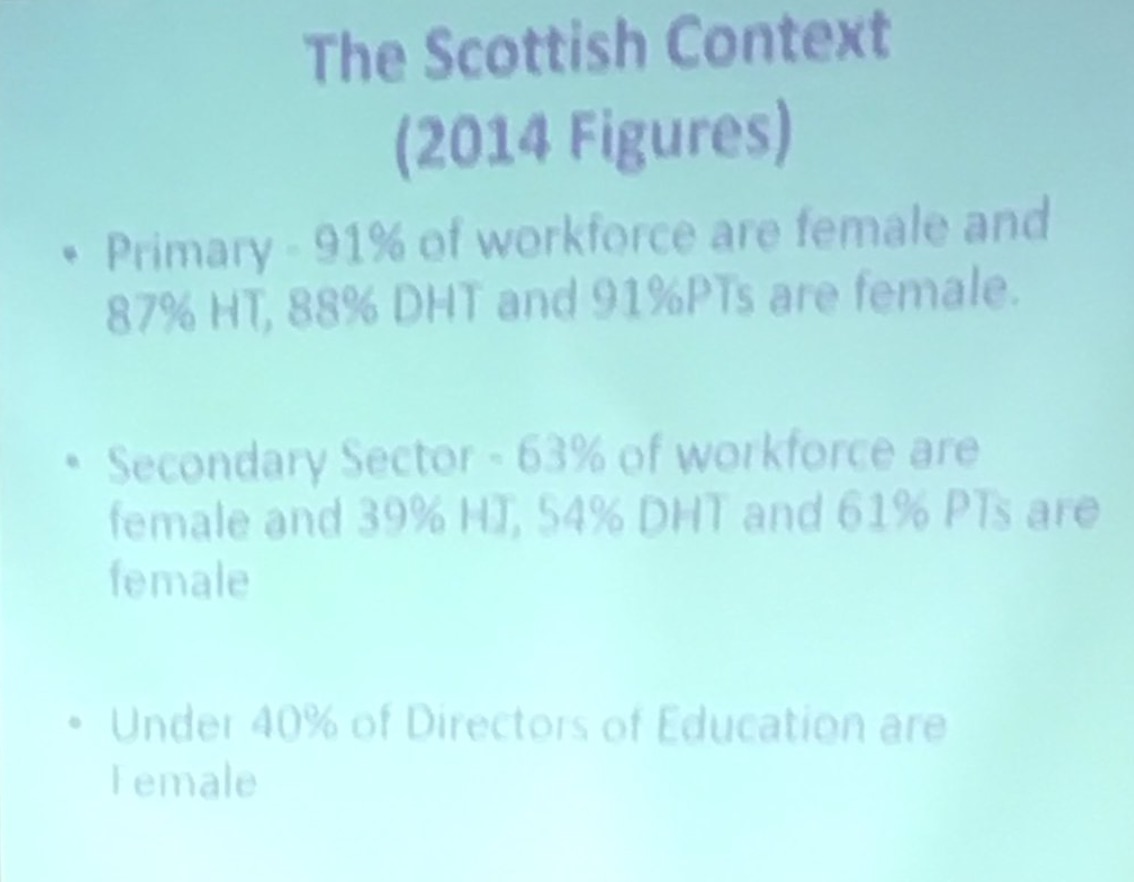
I found myself feeling a bit unsure as the questions about the glass ceiling, leadership traits etc. which make me feel awkward, as I am a strong advocate of nurturing talent, whether that is found in a male or female, but perhaps this is more of a reflection of my own journey. I was interested in the slide from the presentation giving the % of female to male in the workforce and then leadership roles, see below.


Why is the percentage of the workforce not reflected in the percentage in promoted roles?

#WomenEd is based on eight values which are; clarity, communication, connection, confidence, collaboration, community, challenge and change, the 8C’s. For me personally, I are more interested in the #clarity element which raises lots of questions;
What are the issues? Why is there a gender bias (conscious or unconscious)? What about other bias? Is the issue greater for women (and men) of ethnic minority backgrounds? How can we make education more attractive to male graduates? What are the barriers for males coming into education? Why predominantly female? Why is there no partner organisation, MaleEd? What are the barriers? Is there a glass ceiling? (There are definitely differences in how male and female approach promotions and advancement in their career.) How can #WomenEd support and build capabilities, challenge impostor syndrome?

There is no quick fix, the challenges and barriers are complex and interconnected but #WomenEd is a good place to collaborate with like-minded individuals and build a community that can be the drivers of change.

If you want to find out more, the website site, here, has a load of information about the movement and is a good place to start. Both yammer and twitter are being used extensively to build the #WomenEd community. After 1 year there are now 4,500 twitter followers, 500 users on Yammer and 150+ blogs on StaffRm. Regional Leaders are being recruited to host small scale #Leadmeets and there is going to be an Unconference in August in Scotland.


Sunday, 17 April 2016

Teacher professionalism - A prespective from Sachs

More than ten years have passed since the publication of the ‘The Activist Teaching Profession’ Sachs (2003). In a new paper, Sachs “Teacher professionalism: why are we still talking about it?” reflects on the changes that the ten years have made to the teaching profession and I have chosen two themes to discuss which are accountability and professional judgment.

Professionalism is conceived ‘of its time’ through the political and accountability frameworks that either support or constrain it and it is multidimensional. There is evidence to support the fact that professionalism is not one thing but can be many different things. In using the terminology of a ‘mature profession’ Sachs take the view that professionalism is “no longer questioned or contested” (p422) and pulling on Mocker (2005) works, Sachs continues by saying that this tries to help teachers to develop as “creative designers of curriculum and innovative pedagogues”.  Within this ‘mature profession’ teachers will be both creators and consumers of research, individually and collectively, and need to establish a trusting relationship with various stakeholders to become less risk adverse in partnership working. Hargreaves (2000) however, has cautioned that ‘positive new partnerships’ both in and beyond schools as discussed as a way forward by the OECD report (2015) may lead to “the de-professionalization of teachers, as teachers begin to flounder under conditions of uncertainty, multiple pressures and intensified work demands”. However, Sachs also cites Guskey who is more of the mind that “jointly planned activities are consistently more effective and more efficient than those planned by either school-based or district educators working alone (Guskey, 1999)”. This challenge then becomes about how we create ‘third spaces’ where collaboration can develop and more importantly thrive.

Accountability
Accountability has become a key element of professionalism and as such is a driver of the discourse around professionalism. For Bovens, Schillemans, and T’Hart (2006, pp. 226–227) in practice, being accountable is seen as a virtue, as a positive quality of organizations or officials. (p416). So how do we balance this organisational accountability with professional autonomy? In a performance culture, accountability impacts on teacher autonomy and how teachers enact their professionalism. It is sometimes difficult to discuss accountability in a form other than that of ‘perfect information’, data that is easy to measure, which then becomes valued and is the bases of quality indicators, (organisational accountability) in preference to trying to measure the things we do value (professional autonomy). Sachs draws on the work of Bolan and McMahon who argue that the political context defines the direction of travel for the education system and thus does not always support teacher agency, as it narrows the definition of professional learning to a more technical approach of teaching.
However, accountability is a multifaceted, Halstead (1994) distinguishes between two forms of accountability, contractual accountability and responsive accountability.
v  Contractual accountability
Is enacted through Standards, outcomes and results and is based on an explicit and an implicit contract which tends to be measurement driven.  Student test results, literacy and numeracy rates are some examples. It is where the intent of government is compliance and control, and at its worst, leaves teachers little agency or self-regulation.
v  Responsive accountability,
Is enacted through decision-making by teachers and is more concerned with process than outcomes. It supports inclusion and the use of the collective wisdom of the profession to self-regulate practice.
In the current global climate of performativity, it is not surprising that contractual accountability is seen to be preferred over responsive accountability.

Accountability has, in some countries, been through the use of professional standards which have become a tool for managing and overseeing teacher accountability. I would argue that SFR is an accountability measure to ensure the high standards expected of teachers in Scotland, but CLPL is far more about the individual teachers learning journey.  It is not a tick box standard to be ‘got through’ but rather a measure of scope and remit for the individual and thus is less about accountability and more about professionalism. Sachs claims that “the opportunity for teacher professional standards to be a catalyst for authentic professional learning is not being realized” (p417)¸ I would argue that in Scotland this is not the case.
As previously stated accountability is multifaceted and thus “different forms of accountability circulate which in turn produce different outcomes and have different effects on the enactment of teacher professionalism” (p415). Both Sachs and Evetts hold common views of professionalism. Evetts ‘occupational professionalism’ aligns with Sachs ‘democratic professionalism’ and Evetts ‘organisational professionalism’ aligns with Sachs ‘managerial professionalism’. Both authors agree that occupations professionalism (Evetts) or democratic professionalism (Sachs) supports a transformative profession which leads to authentic professional learning. When teacher learning is the focus of professional learning and linked explicitly with student learning, then “teacher accountability is vindicated and at the same time teachers expand their personal and professional horizons” (p421).

Transformative learning can be achieved through teachers and school systems becoming research enriched by being both consumers and creators of research. Teachers can develop the skills required to undertake enquiry, becoming research literate, and by doing so would assume more responsibility for their own learning. Through being “reflective practitioners or inquirers who make decisions about how students learn, how to assess student learning and appropriate pedagogy for the students, s/he teaches based on evidence and experience” (p420), teachers could feel more ‘in control’ of their own learning and thus feel ‘more professional’ and be ready to ask questions of policy and management systems. Within Professional Learning and education systems it “takes courage to ask tough questions and have the skills to find honest answers”(p421). I would encourage teachers to be courageous and move beyond the ‘what works’ agenda to professional learning which meet the needs of the teacher and their students in their situation. So Professional Learning must serve many masters, it must support teachers to continue to ‘sharpen the saw’ (Covey) and also understand and respond to the social element of education and schooling.

Here I would add a note and caution strongly against going down the ‘what works’ route as this does not mention works for whom? Where? When? Or how? Or the social and cultural factors, Stoll states that schools are “situationally unique” and so critical appraisal of an intervention is crucial, we cannot adopt but we may be able to adapt.

Teacher professional judgement
As discussed in recent OECD report (2105), professional judgement is one aspect which can be improved upon in Scotland, Sachs cited Ravitch (2010, p. 163) who states that professional judgement is a measure of a “good accountability system”.
This begs the question, how do we help teachers to develop and have confidence in their professional judgement? Teacher confidence needs to be improved as until recently this not been a driver of accountability, where ‘hard data’, (I would argue easy to measure data) has not been considered more important. This lack of investment in teacher judgement has led to teachers becoming ‘risk adverse’ and ‘more timid in their judgement’ as Sachs states (p432).
When teachers’ judgement and decision-making is questioned, it diminishes teachers’ self-confidence, creativity and the moral purpose that sustain them in ambiguous and difficult situations. It also corrodes their ability to act with confidence and authority and weakens trust.
This works against the notion of the ‘professional’ with professional judgement being the heart of a professionalism and leads to a technician approach to teaching – doing teaching rather than thinking teacher. Changes in teacher attitudes or as Sachs puts it ‘attitudinal development’ can support to develop confidence in professional judgement as “it is intellectual and motivational and is concerned with improvement of individual practice” (p420).

There is a still a shift needed to move accountability from a managerial approach to a more teachers autonomous approach where professional learning in the form of enquiry into their own and others practice becomes a ‘way of being’ to support the attainment and achievement of young people. This shift into becoming more research enriched, being both creators and consumers of research would support teacher professionalism through active engagement in policy discourse and raised confidence in professional judgement, as a means of teacher agency.


Reference
Sachs , J. (2016) Teacher professionalism: why are we still talking about it? Teachers and Teaching: theory and practice, VOL. 22, NO. 4, 413–425